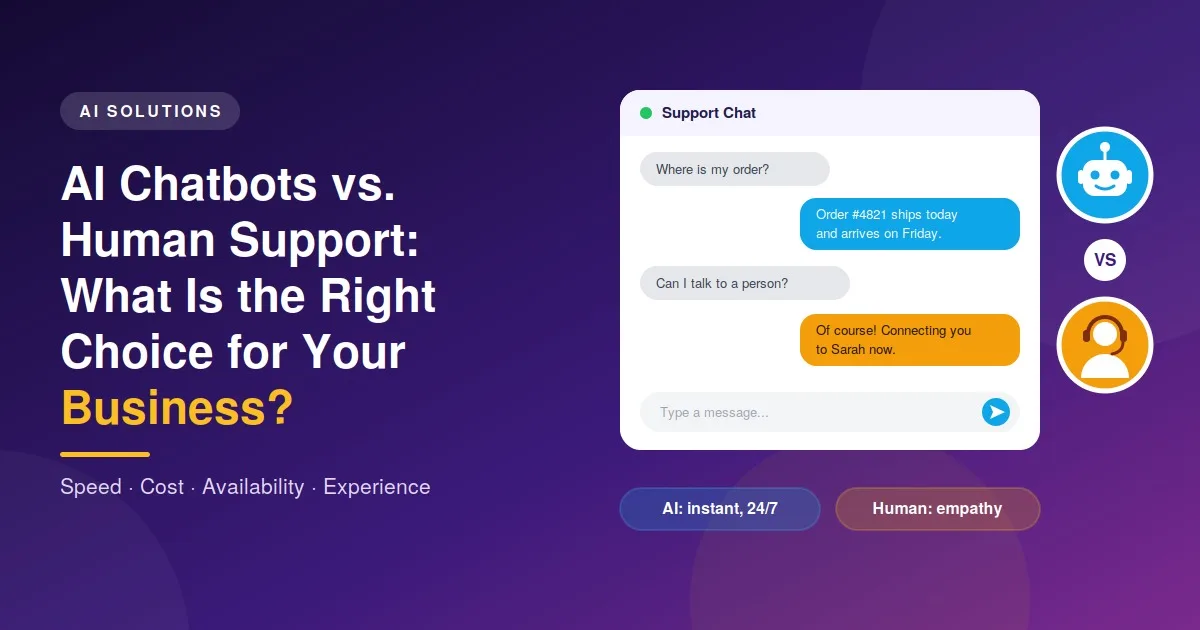
Customers want fast answers, at any hour, from someone who understands their problem. Delivering that is expensive, and it gets harder as you grow. So every business eventually asks the same question: should we use an AI chatbot, a human support team, or both?
The honest answer is that neither is better in every situation. Each has clear strengths and clear limits. This guide compares AI chatbots and human support on response times, availability, operating costs and customer experience, and explains when real people are still essential.
Quick Comparison
| Factor | AI Chatbot | Human Support |
|---|---|---|
| Response time | Instant, even at peak volume | Minutes to hours, depending on staffing |
| Availability | 24/7/365 | Limited to shifts unless you pay for round-the-clock cover |
| Cost to scale | Low cost per extra conversation | Rises with every new agent |
| Consistency | Same answer every time | Varies by agent and mood |
| Empathy | Limited | Strong |
| Complex or unusual issues | Often struggles | Handles with judgment |
1. Response Times
AI chatbots: A chatbot replies in seconds, whether it's talking to one customer or five hundred. There is no queue, no hold music and no waiting for the next free agent. For simple questions such as order status, opening hours, pricing or password resets, that speed is a real advantage.
Human support: Even a great team has limits. During busy periods, such as sales, product launches or outages, wait times grow. Agents also need time to look up information, switch between tools and type a reply.
Verdict: AI wins on raw speed, especially for high-volume, repetitive questions.
2. Availability
AI chatbots: A chatbot doesn't need sleep, holidays or shift changes. It can serve customers in different time zones at 3 a.m. on a Sunday exactly as it does at 10 a.m. on a Monday, across your website, WhatsApp, social media and email.
Human support: Providing round-the-clock human coverage means hiring several shifts or outsourcing, which is costly for small and mid-sized businesses. Most teams operate within set hours, and customers outside them wait until morning.
Verdict: AI wins on availability. It lets even a small business offer support that never closes.
3. Operating Costs
AI chatbots: The costs are mainly upfront and ongoing: development or setup, integration with your systems, a subscription or usage fees, and regular maintenance and updates. Once built, handling one more conversation costs very little, so the cost per ticket falls as volume grows.
Human support: The costs include salaries, recruitment, training, management, equipment and software licences, plus the expense of staff turnover. As ticket volume rises, you usually need more people, so costs grow almost in step with your customer base.
Verdict: AI is usually cheaper at scale, particularly for routine queries. However, a chatbot isn't free. A poorly built one that frustrates customers can cost you more in lost sales than it saves in wages.
4. Customer Experience
This is where the comparison gets more nuanced.
Where AI does well: Customers who just want a quick answer often prefer a chatbot. There's no waiting and no need to explain things twice, and the answer is consistent. Modern AI can understand natural language, remember context within a conversation and personalize replies using customer data.
Where AI falls short: Chatbots can misread unusual requests, give a wrong or overly generic answer, or trap customers in loops with no way out. They don't truly understand frustration, grief or urgency, and customers can tell.
Where humans do well: People can listen, adapt, apologize sincerely, make exceptions and build rapport. For emotional, high-value or complicated situations, that personal touch often decides whether a customer stays or leaves.
Where humans fall short: Quality varies. A tired or poorly trained agent can give slow, inconsistent or incorrect answers, and long queues frustrate customers before the conversation even begins.
Verdict: The best experience depends on the question. Fast and simple favors AI. Complex and emotional favors people.
5. When Human Support Is Still Necessary
Even the best chatbot should know its limits. Keep real people available for:
- Complaints and upset customers. Anger or distress needs empathy, not a scripted reply.
- Complex or multi-step problems. Technical faults, billing disputes and unusual cases need judgment and investigation.
- High-value sales and negotiations. Large deals, custom quotes and enterprise clients expect a personal relationship.
- Sensitive topics. Health, legal, financial or privacy matters call for care and accountability.
- Exceptions and policy decisions. Refunds, goodwill gestures and special arrangements need human authority.
- Requests for a person. If a customer asks for a human, make it easy. Hiding the option damages trust.
The Smart Answer: A Hybrid Model
For most businesses, the right choice isn't AI or humans. It's both, with each doing what it does best.
- AI handles the first line. It answers common questions instantly, collects details and resolves simple issues without human involvement.
- AI hands over smoothly. When a conversation becomes complex, emotional or high-value, the chatbot passes it to a human with the full chat history, so the customer never repeats themselves.
- Humans focus on what matters. With routine queries removed from their queue, agents have more time for the conversations that need skill and empathy.
- Data improves both. Insights from conversations reveal common problems, missing help content and training opportunities.
This approach delivers fast, always-on service without losing the human connection, and it keeps costs under control as you grow.
How to Decide What's Right for Your Business
Ask yourself these questions:
- What share of your enquiries are repetitive? The higher it is, the more value automation brings.
- How many enquiries arrive outside working hours? A lot of after-hours demand makes a chatbot compelling.
- How complex or sensitive is your product or service? The more so, the more humans you'll need.
- What are your customers' expectations? Some audiences strongly prefer speaking to a person.
- How fast is your volume growing? Rapid growth favors automation to avoid ballooning costs.
- What does a poor experience cost you? For high-value customers, a wrong answer is expensive.
Common Mistakes to Avoid
- Replacing humans entirely. This often backfires, especially with complex or emotional issues.
- Using a generic chatbot. A bot that doesn't know your products, policies and tone will give weak answers. Train it on your own content.
- Hiding the human option. Always give customers a clear route to a real person.
- Launching and forgetting. Review conversations regularly and keep improving answers.
- Ignoring integration. A chatbot connected to your CRM, orders and booking system can actually solve problems, not just talk about them.
- Not measuring results. Track response time, resolution rate, customer satisfaction, handover rate and cost per ticket.
Final Thoughts
AI chatbots are faster, always available and cheaper to scale. Human agents bring empathy, judgment and the ability to handle the unexpected. Rather than choosing one, most businesses get the best results by combining them: automate the routine, protect the personal, and make handovers seamless.
When it's built around your customers, your data and your workflows, the right mix lowers costs, speeds up service and leaves customers feeling looked after.
Ready to Build the Right Support Solution?
Our AI Solutions and Custom Software service designs chatbots and support systems around your business, trained on your content, connected to your tools, and equipped with smooth handover to your human team. Contact us today for a free consultation and let's work out the right balance of AI and human support for your customers.
FAQs
Can an AI chatbot completely replace human customer support?
For most businesses, no. Chatbots handle routine questions very well, but complaints, complex problems and sensitive situations still need people. A hybrid model works best.
Are AI chatbots cheaper than human support agents?
Usually, once they're running, especially at high volume, because each extra conversation costs very little. You still need to budget for setup, integration and ongoing improvement.
Do customers like talking to chatbots?
Many do for quick, simple requests, because the answer is instant. Customers get frustrated when a bot can't understand them or won't let them reach a person, so a clear route to a human is essential.
What is a hybrid support model?
It's a setup where an AI chatbot handles first contact and routine queries, then passes complex or sensitive conversations to human agents along with the full conversation history.
What kinds of businesses benefit most from chatbots?
Businesses with high volumes of repeat questions or customers in many time zones, such as e-commerce, SaaS, travel, education and service companies, tend to benefit the most.
Can a chatbot be customized for my business?
Yes. A custom chatbot can be trained on your own documents and policies, speak in your brand voice, and connect to your CRM, order system or calendar to take real actions.